
When comparing aerogel powder for sale, technical buyers should verify the silica aerogel grade, particle-size distribution, hydrophobic treatment, thermal target, packaging, and batch documentation. A short, controlled sample review usually reveals more than a headline conductivity value alone.
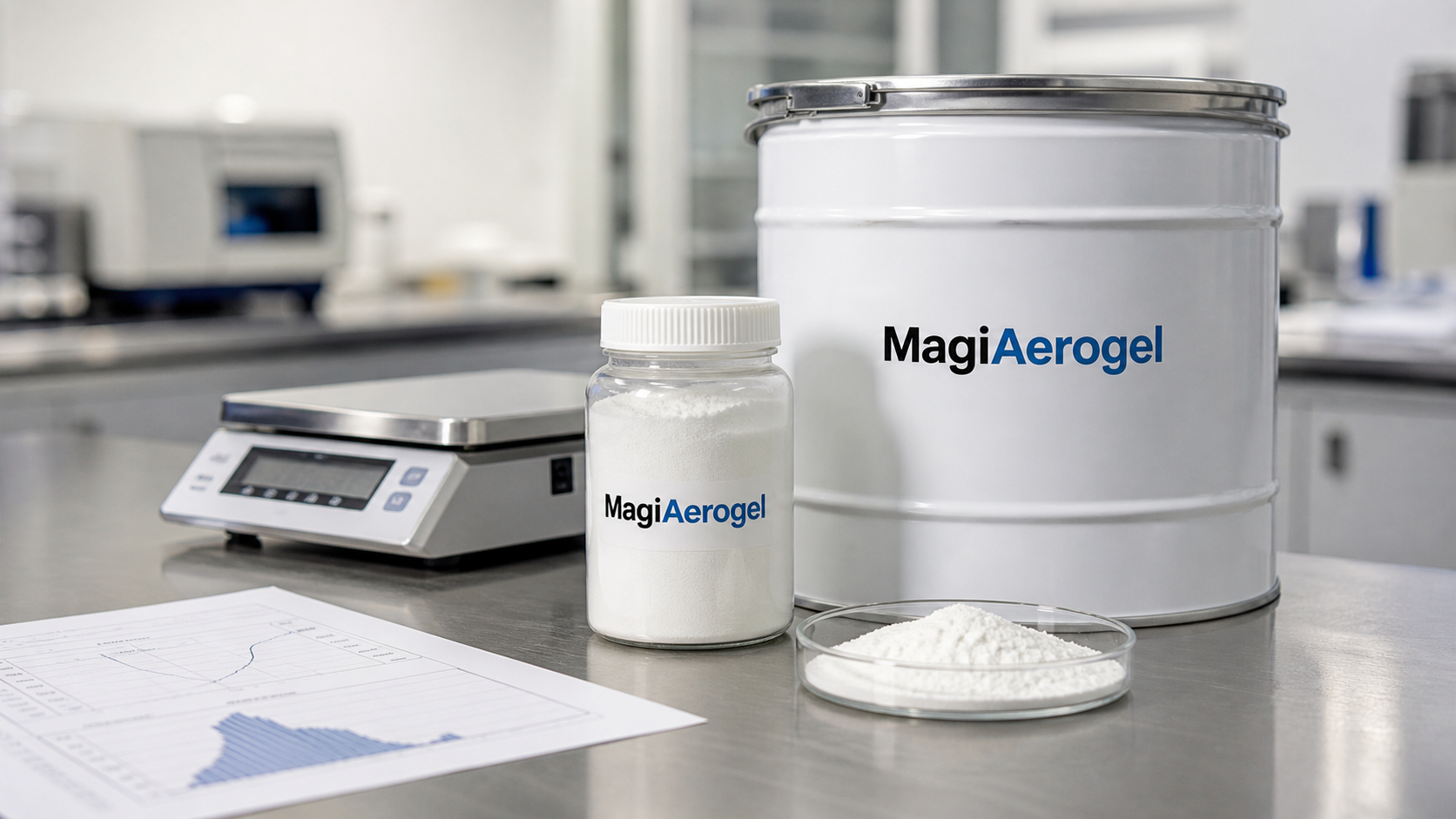
What should buyers verify before choosing aerogel powder?
The right powder is the one that fits the formulation process, not simply the one with the lowest quoted price.
Review the intended matrix, mixing energy, target density, temperature range, and moisture sensitivity before requesting a final quotation. For a technical comparison, ask suppliers to state the test method, lot basis, and permitted variation beside every key number.
Use this first-pass checklist:
- silica aerogel grade and surface treatment
- particle-size distribution and coarse-particle limit
- bulk density and moisture condition
- thermal-conductivity test basis and temperature
- packaging unit, minimum order, and lot traceability
How does particle size affect formulation control?
Particle size influences dispersion, dust management, viscosity, and the repeatability of the finished compound.
Ask for D10, D50, D90, the maximum particle size, and the measurement method. A narrow distribution may improve repeatability, while a broader distribution can be useful when the matrix needs a particular packing profile; the decision belongs to the formulation trial.
Run at least three dosage points with the same mixing sequence. Record powder temperature, open time, mixer speed, and final viscosity so the comparison reflects process behavior rather than operator preference.
When is hydrophobic aerogel powder the better choice?
Hydrophobic treatment is most valuable when moisture pickup would reduce insulation performance or destabilize the blend.
For a moisture-sensitive application, compare sealed and opened samples, note storage time, and request the supplier’s water-repellency or moisture-uptake test. Keep the wording hydrophobic aerogel powder tied to a stated test method rather than treating it as an unqualified performance guarantee.
The silica aerogel powder product is a useful starting point for matching the material description to the current technical data. Buyers should approve the exact grade and revision before production release.
Which supply checks reduce bulk-order risk?
A reliable bulk order connects the sample, lot, package, and production schedule in one traceable record.
Compare sample identity with the aerogel powder bulk material supply option and confirm whether the quoted pack size matches the intended monthly consumption. Then record the minimum order, lead time, storage condition, and replacement process for out-of-spec material.
| Buyer checkpoint | Practical starting point | Why it matters |
|---|---|---|
| Trial dosage points | 3 or more | Shows formulation response |
| Sample quantity | 5 kg, 25 kg, or 100 kg options | Matches trial and production scale |
| Lot records | 1 record per lot | Preserves traceability |
| Storage review | 24-hour moisture check | Flags handling sensitivity |
For broader product matching, review the silica thermal filler powder listing and request the current datasheet, COA, and packaging specification.
Compare powder options for your formulation
Match silica aerogel grade, treatment, particle size, and pack size to the next controlled trial.
How should a technical buyer structure the first trial?
A controlled trial should change one meaningful variable at a time and preserve the evidence needed for scale-up.
Start with a written target for density, thermal performance, viscosity, and application method. Test three powder loadings, keep the mixing order fixed, and record the lot number, conditioning time, and final inspection result.
Use authoritative technical context such as the U.S. Department of Energy when framing insulation-efficiency discussions, but rely on the supplier’s current datasheet and your own validated test method for purchasing decisions.

What is the practical buying conclusion?
Choose aerogel powder on demonstrated formulation fit, documented batch control, and a supply plan that can survive scale-up.
The best next step is to request a defined sample, compare at least three loading points, and confirm the commercial pack before approving a production lot. Keep the product line, routing tag, and technical documentation aligned from the first inquiry through the purchase order.
Aerogel powder buyer FAQs
What particle-size range should buyers request for aerogel powder? Start with the supplier’s available range, commonly about 1 to 500 micrometres, and confirm D50, the coarse-particle limit, and the test method.
How much aerogel powder should be used in a first formulation trial? A controlled trial can begin with 5% to 20% by weight across at least three dosage points, subject to the target matrix and validated test results.
What hydrophobicity check is useful for incoming powder? Compare three samples per lot and review moisture gain after 24 hours under the defined test conditions, using the supplier’s stated water-repellency method.
What bulk quantity and packaging details should be confirmed? Compare 5 kg, 25 kg, and 100 kg supply steps with the minimum order, lead time, moisture protection, lot traceability, and storage requirements.