
Aerogel insulation sheets should not be approved from a price comparison or a single thermal claim. Buyers need to confirm how the silica aerogel sheet fits the enclosure, handles during cutting, arrives across production lots, and supports the documentation required for release. A controlled sample and fit review turns a thin insulation concept into a repeatable engineered component.

The short answer for technical buyers
Aerogel insulation sheets are ready for approval only when thermal intent, dimensional fit, handling behavior, and production documentation are reviewed together.
Start with four linked checks:
- Confirm the target assembly and available insulation envelope.
- Define measurable sheet dimensions and surface acceptance criteria.
- Run a cutting and fit trial using the real enclosure geometry.
- Agree on lot identification, packaging, and release documents.
The MagiAerogel silica aerogel sheet panel provides a useful product basis for that conversation because it is positioned for thin thermal barriers, engineered assemblies, and project-based procurement.
Why price and a datasheet are not enough
Two sheets can look comparable on paper while creating very different fabrication and assembly risk.
Price does not show whether edges remain clean during cutting, whether the panel fits around fasteners, or whether the same handling method works across repeated lots. A datasheet also cannot replace the drawing-level decision about where aerogel insulation panels sit inside the complete tolerance stack.
| Buyer question | Evidence to request | Risk if omitted |
|---|---|---|
| Will the sheet fit the real assembly? | Drawing review and physical fit trial | Interference, gaps, or enclosure rework |
| Can the sheet be converted consistently? | Cutting method and first-article samples | Edge damage and variable component size |
| Will incoming lots be traceable? | Lot ID and inspection record | Difficult root-cause review |
| Will export packaging protect the surface? | Packaging specification and photos | Compression, contamination, or damaged corners |
Fit should be checked at assembly level
A thin aerogel insulation sheet still needs clearance for neighboring parts, fasteners, covers, and normal production variation.
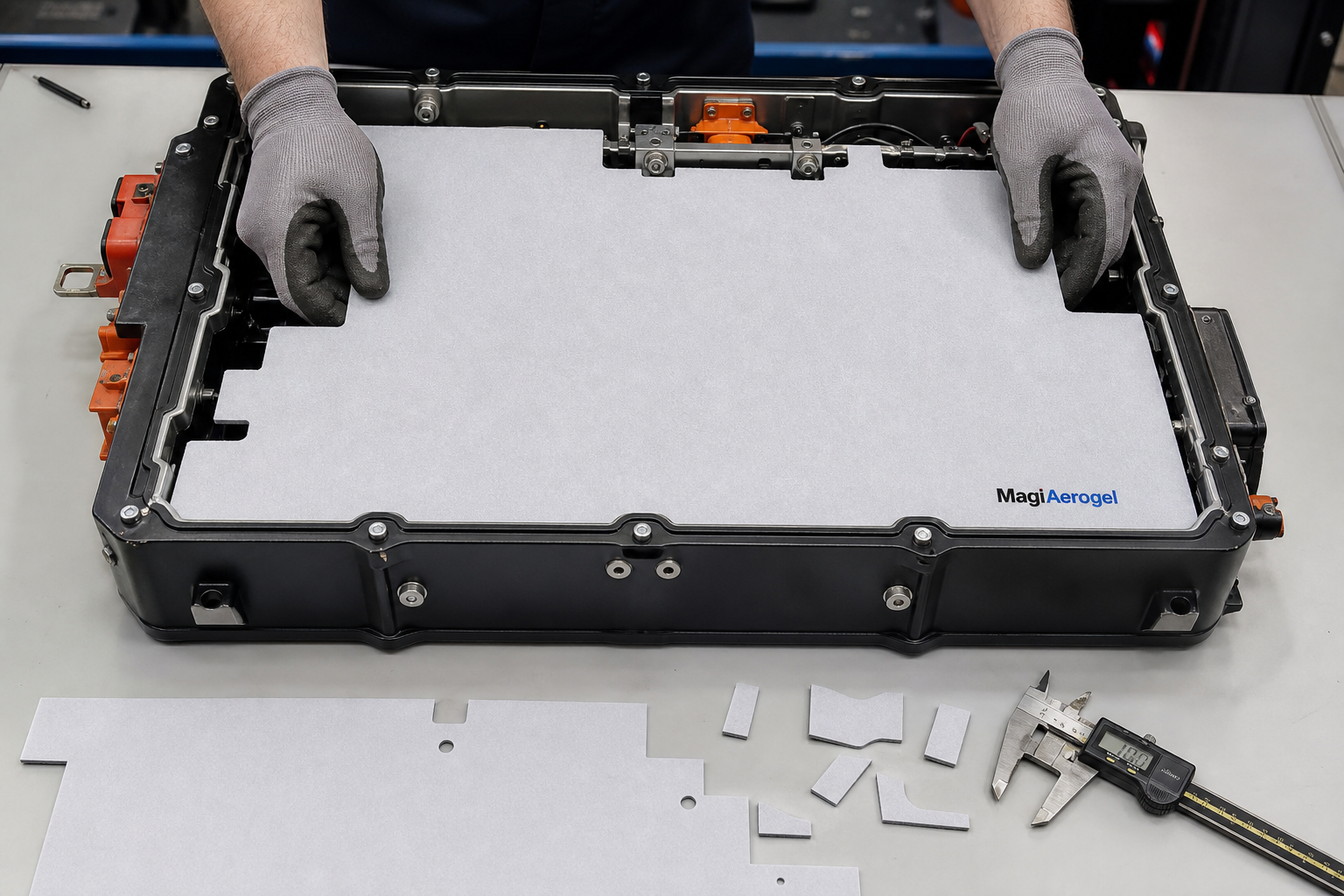
Review the sheet inside the complete assembly rather than measuring it in isolation. The fit trial should use representative brackets, covers, cable routes, and service openings, then record where the sheet may compress, lift, or interfere with closing hardware.
The earlier guide on reducing aerogel sheet panel rework is a useful internal reference when the project needs a more detailed first-article and enclosure review.
Review the sheet format before release
Use the product page to align the silica aerogel sheet format with your enclosure, cutting, documentation, and packaging requirements.
Compare formats by integration need
The best format is the one that solves the assembly constraint without adding avoidable conversion work.
| Format | Strongest integration case | Main buyer check |
|---|---|---|
| Silica aerogel sheet | Flat or lightly formed thermal barrier layers | Drawing fit and edge condition |
| Rigid aerogel panel | Stable flat placement with mechanical support | Mounting and dimensional tolerance |
| Flexible blanket | Curved surfaces and wrap-style installation | Overlap, compression, and jacket fit |
| Aerogel coating | Thin applied layer on suitable prepared surfaces | Surface preparation and cured-film control |
This comparison does not make one format universally better. It helps buyers identify when aerogel panels, a flexible blanket, or a coating would integrate more cleanly than aerogel sheets.
Build a measurable incoming inspection
A short inspection record is more valuable than a long specification that nobody checks at receipt.
Use a repeatable release checklist:
- record the production lot and package ID
- inspect corners, faces, and protective packaging
- measure length, width, and thickness at agreed locations
- compare the sheet with the approved first article
- record accept, hold, or reject disposition
- retain photographs when damage or drift is found
For energy-efficiency projects, the U.S. Department of Energy is a useful external context source, but project approval should still rely on the buyer’s design calculations, test evidence, and final production-grade documentation.
Final decision rule
Approve the aerogel sheet only after the material has passed a real fit trial and the supplier has accepted measurable release criteria.
A strong sourcing decision connects silica aerogel material intent to the actual enclosure, conversion process, incoming inspection, and documentation package. That approach reduces the chance that an attractive quote becomes repeated panel rework after production begins.
FAQs
These answers provide procurement starting points and should be adjusted to the risk and drawing requirements of the project.
How many aerogel sheet samples should a buyer inspect before approval?
A practical qualification plan starts with at least 3 independently selected sheets and measures 5 to 10 locations per sheet. These are inspection-plan targets, not guaranteed product specifications, so the final count should match the buyer’s risk level and drawing requirements.
What dimensional tolerance should be written into an aerogel sheet RFQ?
The RFQ should state a project-specific length, width, and thickness tolerance rather than accepting a verbal promise. For tight enclosure work, buyers should calculate the complete tolerance stack and reserve at least one documented fit trial before releasing production quantities.
How many production lots should be included in the first consistency review?
Reviewing 3 production lots is a useful starting point for checking whether sheet dimensions, surface condition, packaging, and handling remain stable. Higher-risk assemblies may need more lots or a formal sampling standard agreed before purchase.
What should an incoming aerogel sheet inspection record contain?
Record at least 5 fields: lot ID, sheet dimensions, surface condition, packaging condition, and disposition. Add photographs and measurement locations when the sheet will be cut into tolerance-sensitive insulation panel components.