
What technical buyers often miss is that aerogel blanket insulation is a system decision, not just a low-conductivity material purchase. A silica aerogel blanket must match the temperature range, available clearance, surface geometry, facing, fastening method, and project handling plan. The right comparison therefore starts with installation constraints and ends with verified parameters.

What should buyers verify first?
Start with the operating envelope and the space available for the complete insulation system.
Before comparing quotations, record the operating temperature, target heat-loss or surface-temperature requirement, substrate material, minimum clearance, exposure conditions, and expected maintenance access. This prevents a flexible blanket from being selected on nominal thickness alone.
The most useful first-pass checklist is:
- continuous and peak temperature limits in °C
- nominal thickness and permitted compression
- roll width, cut tolerance, and seam treatment
- facing type and resistance to handling or moisture exposure
- fastening, jacket, and inspection requirements
How does aerogel blanket insulation change the thickness decision?
Silica aerogel can provide high thermal resistance in a thin, flexible format, but the installed build still controls performance.
Compare the material’s declared thermal conductivity at the temperatures relevant to the project. Then check whether the stated value assumes a specific density, test method, orientation, or compression level. A catalogue number is useful only when the measurement basis is clear.
For a practical supplier comparison, review a silica aerogel blanket against the same thickness, temperature, and installation assumptions. The 10 mm flexible aerogel blanket roll is a useful reference point for projects where clearance and conformability matter.
| Buyer check | Why it matters | Evidence to request |
|---|---|---|
| Thermal conductivity | Sets the heat-flow comparison | Test basis and temperature points |
| Thickness tolerance | Affects fit and installed resistance | Nominal and minimum thickness |
| Compression limit | Prevents over-tight fastening | Installation limit in mm or % |
| Facing and seams | Protects the material in handling | Facing specification and seam method |
| Temperature range | Protects the whole assembly | Continuous and peak limits in °C |
Which product format fits industrial surfaces?
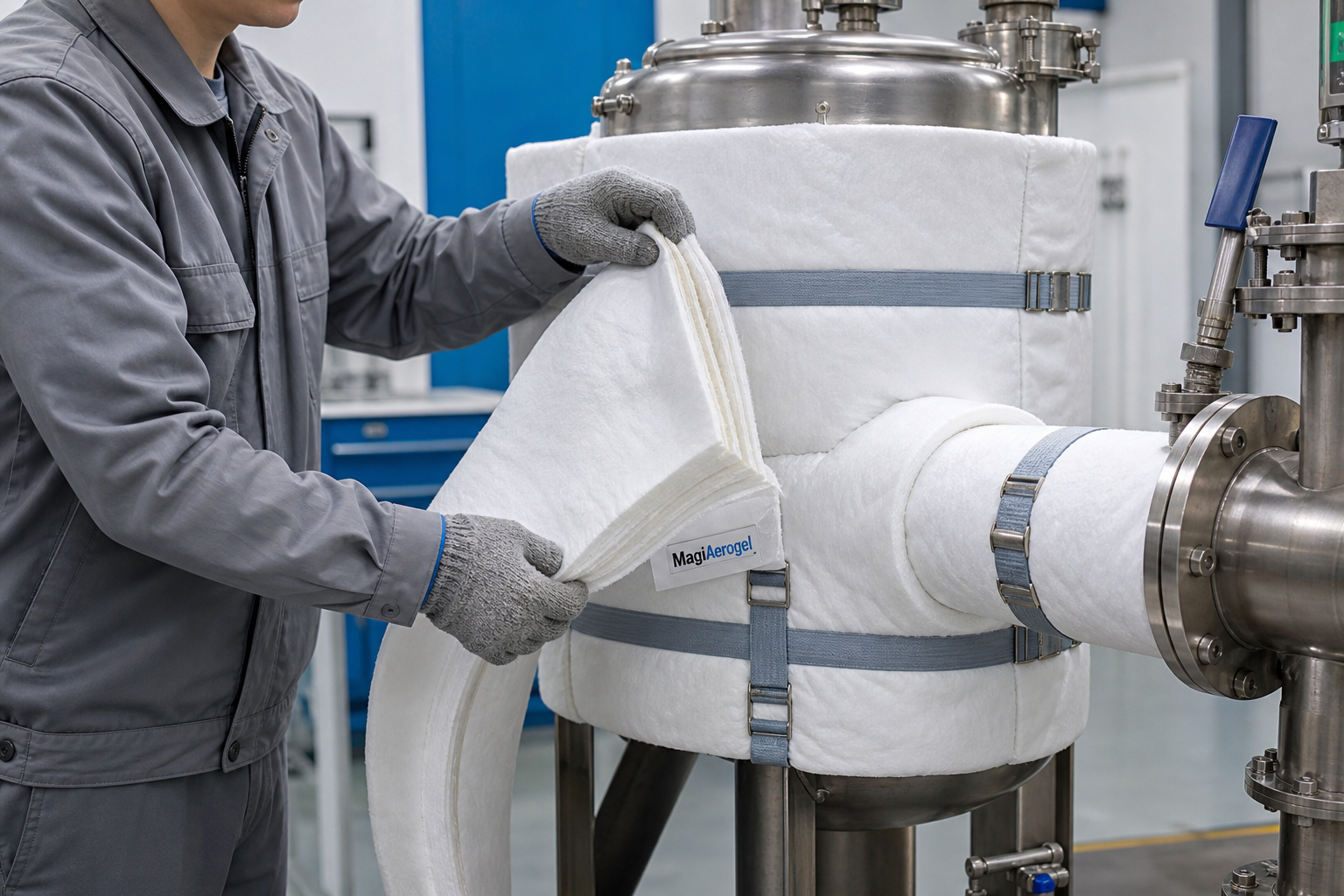
Flexible aerogel blankets are strongest when the insulation must follow curves, narrow clearances, or irregular equipment geometry.
Use a blanket when the project involves vessels, short pipe runs, flanges, or equipment with frequent changes in contour. For flat sections, confirm whether a cut sheet or panel would reduce seams and simplify installation; do not assume that one format is optimal for every surface.
The white nonwoven aerogel blanket roll can be reviewed when the facing, cutting behavior, and clean handling of the outer layer are important. Ask for sample dimensions and a seam plan before approving a large order.
What installation details affect the result?
Good installation preserves coverage, controls compression, and makes seams and penetrations repeatable.
Plan the blanket layout around nozzles, supports, valves, inspection points, and removable sections. Define the overlap method, fastening spacing, outer jacket, and repair procedure before the first roll is cut.
For curved equipment, a short trial section can reveal whether the blanket bridges a radius or leaves a gap. Record the actual installed thickness at seams and around penetrations, because those locations often determine the practical result.
How should suppliers be compared beyond price?
The lowest material price is not necessarily the lowest installed cost.
Compare the complete package across these commercial and technical fields:
- documented thermal data at project temperatures
- minimum order quantity, roll dimensions, and lead time
- cutting, seam, fastening, and outer-jacket guidance
- sample approval and replacement process for damaged material
- technical support during installation and inspection
For a broader energy-efficiency context, buyers can also consult the U.S. Department of Energy when framing project-level efficiency goals. The authority reference supports the decision context; the supplier still must provide product-specific limits and test evidence.
Compare blanket options for your project
Match thickness, facing, and installation method to the vessel or pipe geometry before requesting a final quotation.
What is the buyer-ready decision?
Approve the blanket only after the material data and the installed design agree.
The strongest procurement package states the temperature range, thickness tolerance, compression limit, facing, roll dimensions, overlap method, and inspection requirements. It should also identify which values are guaranteed and which depend on installation.
For a final cross-check, review the 10 mm silica aerogel insulation blanket against the project drawing and trial section. This keeps the decision focused on measurable fit, performance, and supply risk.
B2B FAQs
What thickness range should buyers compare for an aerogel blanket?
Start with the heat-loss target and available clearance, then compare common 5- to 10-mm constructions before moving to thicker builds. Confirm the final thickness against operating temperature, surface geometry, and outer protection.
How much installation overlap is normally allowed?
A practical starting point is a 25- to 50-mm overlap at seams, subject to supplier guidance and surface geometry. Confirm whether compression, fastening bands, or a removable jacket changes the effective thickness.
What temperature limit must be checked before ordering?
Require both continuous and peak limits in °C for the full assembly. Confirm separate limits for the facing, seams, adhesive, and fastening system where those parts are used.
Can a flexible aerogel blanket fit around vessels and short pipe runs?
Yes, when the roll width, bend radius, seam layout, and fastening method are compatible. Request a drawing or sample fit check when nozzles, valves, or clearance below 25 mm make installation tight.