
When buyers compare aerogel blanket insulation, supplier claims do not answer the installation questions that decide project risk: will the roll fit the available clearance, hold its thickness at seams, and arrive with consistent facing and lot identification? A silica aerogel blanket should be qualified as an installed system, not only as a laboratory sample.
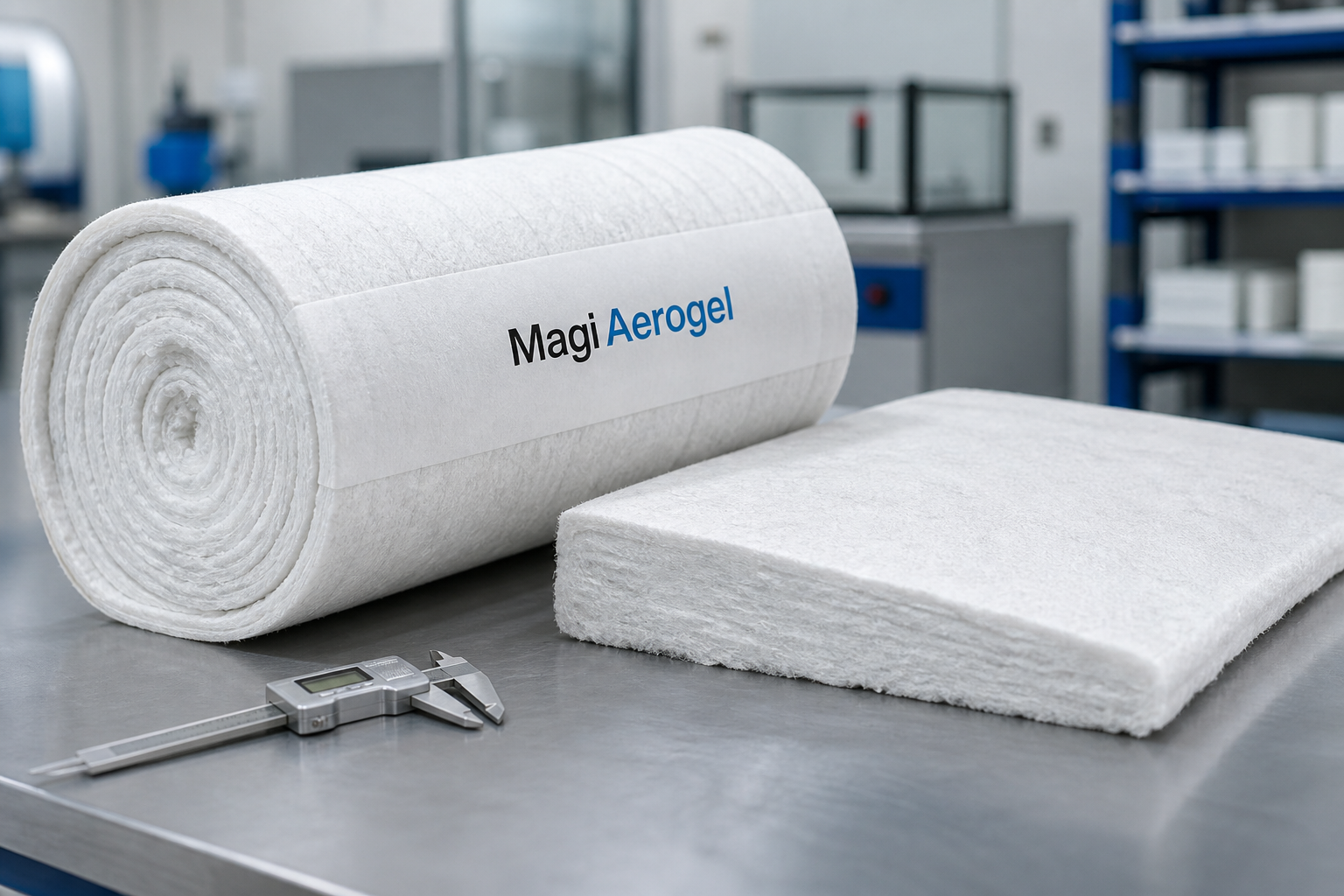
How does aerogel blanket insulation reduce installation risk?
Silica aerogel blanket combines a low-conductivity aerogel core with a flexible fibrous carrier, allowing insulation work in spaces where rigid boards are difficult to fit. The benefit depends on controlled thickness, clean cutting, stable overlaps, and a fastening method that does not create avoidable thermal bridges.
Before approving a supplier, compare the published details for the MagiAerogel 10 mm flexible aerogel blanket roll with your clearance drawing. Record nominal thickness, width, roll length, facing, maximum service temperature, packaging, and the lot number tied to the sample.
What should buyers check before buying an aerogel insulation blanket?
Use a short, repeatable receiving and installation checklist:
- Thickness and width: measure at several points rather than accepting the label value alone. A 5 mm or 10 mm nominal blanket needs an agreed tolerance after handling.
- Compression recovery: check whether the blanket returns to its expected thickness after cutting, packing, and fastening. Document the test time and load.
- Seam overlap: define a practical 25 to 50 mm overlap range and identify how seams will be secured around bends, flanges, and access points.
- Facing and edge condition: reject torn facing, open edges, wet packaging, or contamination that can compromise handling and enclosure fit.
- Traceability: keep the sample, batch number, packing list, and installation area linked so a field issue can be investigated quickly.
For a nonwoven option, compare the MagiAerogel white nonwoven aerogel blanket roll against the facing and handling requirements in your work instruction. Ask the supplier to state whether the quoted roll length and width are nominal or guaranteed delivered dimensions.

How should a flexible aerogel blanket be wrapped around pipe and vessels?
Plan the cut pattern before the crew opens the roll. Measure the outside diameter, mark longitudinal and circumferential seams, and keep the blanket smooth without forcing folds into elbows or around fittings. Around a pipe or vessel, the outer jacket and fastening system should hold the blanket in contact without crushing the insulation at every strap or pin.
For a silica insulation comparison, review the MagiAerogel 10 mm silica aerogel insulation blanket against the project temperature, thickness, and facing requirements. Confirm whether the delivered format is suitable for the bend radius, access doors, and planned jacket system before ordering the full quantity.
Buyers should also define storage limits. Keep rolls dry, off the floor, protected from sharp edges, and sealed until cutting. Reinspect any package exposed to water or stored for more than 30 days before installation.
A practical supplier decision for aerogel blankets
Choose the supplier that gives your team a measurable installation window, not simply the lowest roll price. Approve a sample by documenting thickness, width, overlap, fastening, temperature range, and packaging condition. Then use the MagiAerogel aerogel blanket series to keep repeat orders aligned with the same product line.
For energy-efficiency context, consult the U.S. Department of Energy efficiency resources as an external reference, then validate project-specific thermal and fire requirements with your own test method and governing specification.
For a focused risk review before site work, see the related aerogel blanket installation risk checks. It supplements the product qualification steps above; it does not replace the required product and series checks.
B2B FAQs
What thickness should buyers request for aerogel blanket insulation?
Start with the specified 5 mm or 10 mm thickness and allow no more than 0.5 mm variation in a qualification sample unless the project specification is tighter. Confirm thickness after compression and at the finished overlap.
How much overlap is practical when installing a silica aerogel blanket?
A practical starting range is 25 to 50 mm at longitudinal and circumferential seams. Follow the project drawing and record any overlap below 25 mm as a deviation.
What temperature range should buyers use for blanket qualification?
Screen the planned operating range, such as -40 to 200 degrees C, and extend testing to 650 degrees C only when the selected grade and facing are specified for that service.
How many rolls should a buyer inspect before approving a blanket lot?
Inspect at least 3 rolls from a small qualification lot and at least 5 rolls from a production lot. Increase sampling when any thickness, width, damage, packaging, or traceability result fails.