
When buyers compare aerogel powder, the lowest quoted price rarely answers the harder question: will the material stay consistent through storage, dosing, and final blending? For industrial formulations, silica aerogel performance depends on moisture control, bulk density, particle handling, and a supply lot that matches the approved reference sample.
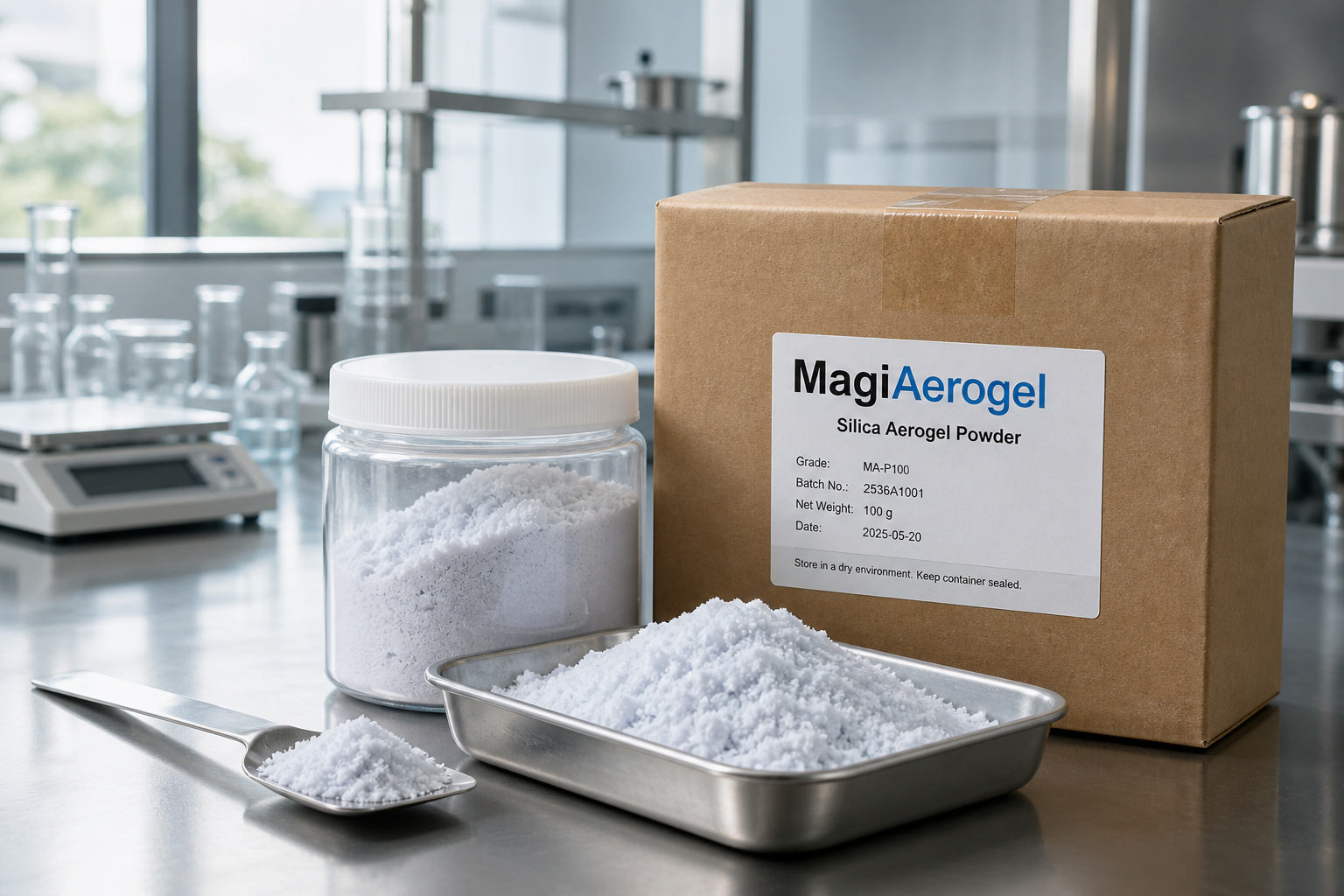
Why aerogel powder deserves a formulation review
Aerogel powder is a lightweight filler and thermal-control material, but its low density makes small process differences visible. Buyers should evaluate more than thermal conductivity. Check how the powder behaves when transferred, how quickly it picks up moisture, and whether the same dosing method works across a 5 kg lab batch and a 100 kg production trial.
For a baseline material review, compare the published details for MagiAerogel silica aerogel powder with the specification sheet used by your formulation team. Record particle-size method, hydrophobic treatment, packaging, lot identification, and the agreed test conditions.
What should buyers check before buying aerogel powder?
Use a short qualification checklist:
- Moisture protection: define a receiving limit, such as no more than 1.0% by the agreed test method, and keep containers sealed after sampling.
- Bulk density: compare the lot against an approved reference and investigate movement beyond plus or minus 10%.
- Flow and dispersion: test the actual feeder, mixer, and carrier system instead of relying only on a laboratory scoop test.
- Packaging and lot control: confirm net weight, inner liner, batch number, storage temperature, and resealing instructions.
- Trial quantity: separate a 5 to 25 kg qualification lot from the 100 kg or larger production trial so failures remain traceable.
The aerogel powder bulk material supply option is useful for comparing packaging and replenishment assumptions. Ask the supplier to state whether the quoted price covers a fixed lot, a recurring monthly quantity, or a forecast-based supply agreement.

How do hydrophobic aerogel powder and dosing affect risk?
Hydrophobic aerogel powder can reduce sensitivity to incidental moisture, but it does not remove the need for controlled storage. A buyer should define the maximum open-container exposure window, the acceptable flow condition, and the re-test trigger for clumping or density drift.
If the powder is used as a silica thermal filler, review the MagiAerogel silica thermal filler powder against your resin, binder, or carrier system. Confirm that the selected grade disperses without excessive shear, dusting, or unplanned viscosity change. For broader context on blend stability, see the related aerogel powder blend-drift buyer checks.
A practical purchasing decision
Choose the grade that gives your team a repeatable process window, not simply the lightest or cheapest sample. Document the approved lot, moisture result, bulk-density range, mixing sequence, and packaging condition. Then use the MagiAerogel aerogel powder series to keep future sourcing aligned with the same product line.
For technical background on energy-efficiency priorities, consult the U.S. Department of Energy as an authority reference, then confirm project-specific performance with your own test method and operating limits.
B2B FAQs
What order size should buyers request for aerogel powder qualification?
Start with a 5 to 25 kg qualification lot for a new formulation, then move to a 100 kg or larger production trial after moisture, density, and blend stability are accepted.
What moisture limit matters when receiving silica aerogel powder?
Many teams begin with no more than 1.0% moisture by the agreed method. Recheck any lot exposed for more than 24 hours or showing clumping.
How much bulk-density variation is acceptable between powder lots?
A practical starting limit is plus or minus 10% from the approved reference lot. Volumetric dosing may require a tighter plus-or-minus 5% range.
How long can opened hydrophobic aerogel powder remain in use?
Use a 24 to 72 hour internal exposure limit unless packaging and climate testing supports longer storage. Reseal after every draw and reject material with moisture pickup or failed flow checks.