
Aerogel sheet projects create expensive rework when buyers approve silica aerogel sheet from a datasheet alone and wait until pilot assembly to confirm cavity depth, cut geometry, and edge handling. The shorter answer is yes: aerogel sheet can cut enclosure rework, but only when the panel is qualified as a fit-controlled insulation component instead of a generic thermal material.
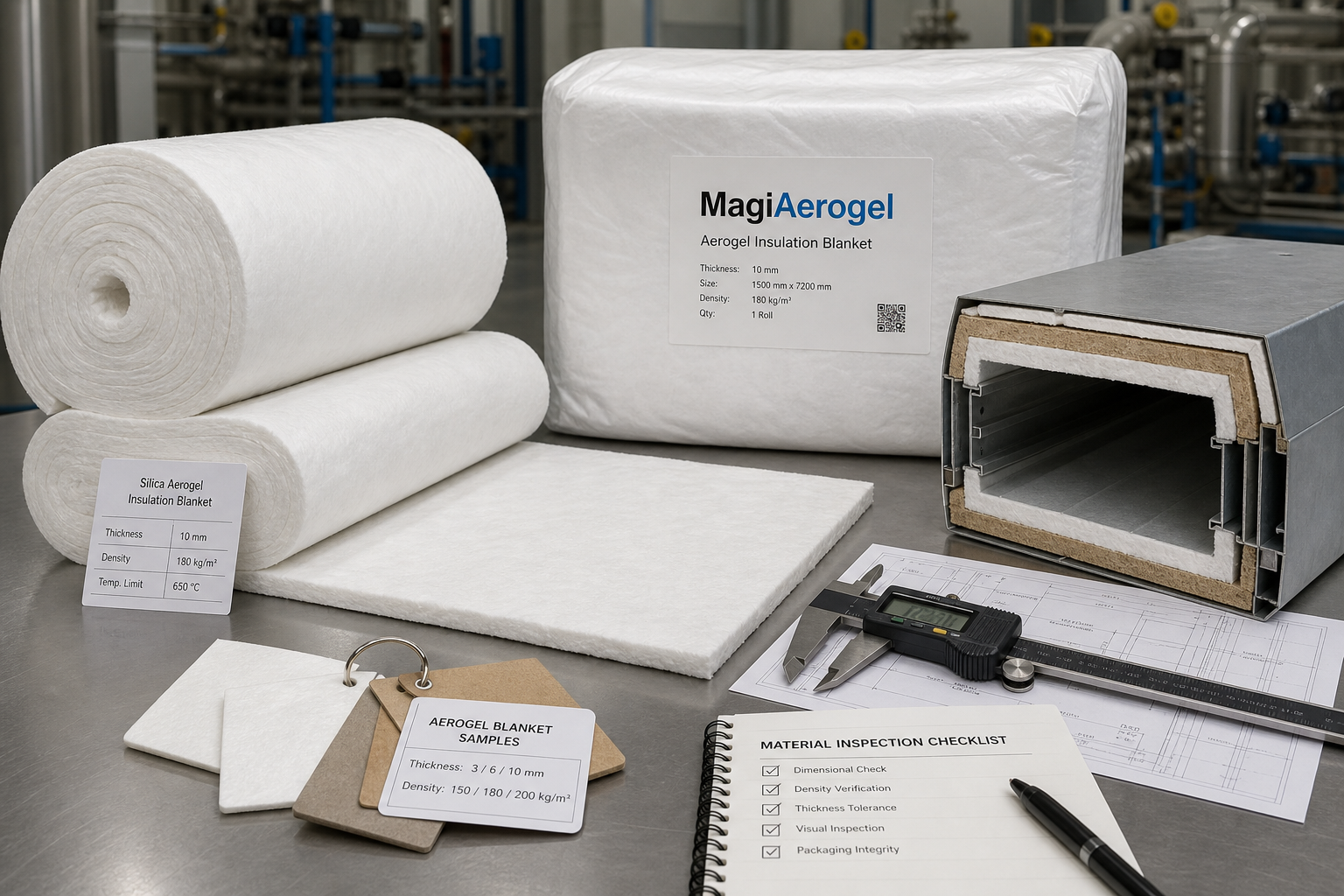
Where enclosure rework usually starts
Most failures appear before the first scaled build:
- The cavity depth on drawings is treated as final even though brackets, latches, or liners change the usable gap.
- The buyer approves nominal thickness but does not define a real tolerance band.
- A thin aerogel insulation sheet is selected without mapping screw heads, cable exits, or corner radii.
- The team assumes any installer can trim the panel cleanly on site without a cut-control rule.
That is why the aerogel sheet silica insulation panel should be reviewed as a dimensional-fit product, not just as a thermal datasheet. Buyers who compare broader aerogel insulation solutions earlier usually catch whether the project really needs a panel format or a different silica aerogel approach.
Short answer: rework drops when three controls are fixed early
| Control | What to define first | Why it matters | | — | — | — | | Thickness band | Target panel thickness and tolerance window | A panel that is off by even 0.5 mm can create stack-up issues in a narrow enclosure. | | Geometry map | Cutouts, fastening points, and corner zones | Fit errors usually come from real hardware, not from the flat center area. | | Handling rule | Cutting method, edge acceptance, and packing | A rigid aerogel panel that chips during kitting can fail before installation starts. |
If those three controls are set before release, aerogel insulation panel procurement becomes easier to defend with engineering, production, and purchasing.
What technical buyers should compare
Technical buyers usually get a better answer when they compare:
- actual thickness tolerance instead of nominal thickness only
- edge condition after cutting, packing, and re-handling
- panel flatness across the full part instead of one sample corner
- enclosure-fit repeatability across at least two geometry zones
- pre-cut kit logic versus field-trim logic before the first PO
The broader MagiAerogel products page is useful when the team needs to compare whether an aerogel board alternative, blanket, or coating format would reduce assembly complexity more effectively than a flat-sheet choice.

Fit-risk comparison for sheet buyers
| Buyer question | Lower-risk answer | Higher-risk answer | | — | — | — | | Is cavity depth measured on the real assembly? | Yes, across multiple units | No, only nominal drawings are used | | Are cutouts and penetrations mapped? | Yes, before sample approval | No, they are handled during install | | Is edge damage acceptance defined? | Yes, with visible pass-fail rules | No, incoming inspection is subjective | | Is the trim method controlled? | Yes, tooling and clearance are planned | No, each installer improvises |
When silica aerogel sheet is the stronger format
Silica aerogel sheet is usually the better choice when the buyer needs:
- flat coverage inside access panels or housings
- repeatable dimensions for kit-based assembly
- thin thermal protection behind liners or skins
- cleaner enclosure fit than a flexible wrap can provide
If the project involves heavy bending or irregular wrap geometry, buyers should compare flexible formats before freezing the panel approach. The U.S. Department of Energy remains a useful outside reference because it keeps the insulation discussion tied to measurable heat-loss control and system efficiency.
Final decision rule
Buyers cut enclosure rework when they qualify aerogel sheet as a fit-controlled panel system, not as a generic material line. If thickness tolerance, cut geometry, and handling rules are fixed before release, silica aerogel sheet is far easier to scale with fewer install corrections and less wasted labor.
FAQs
What thickness tolerance should buyers request first?
A practical first target is about plus or minus 0.5 mm on thin panels, then tighter if the enclosure gap is below 5 mm. That keeps fit checks realistic before the first production PO.
How much trim clearance is normal around cutouts?
Many teams plan 2 mm to 5 mm around latches, cable exits, and fasteners so the panel can seat without edge crush. Less than 2 mm often leaves too little room for repeatable field trimming.
When is a rigid aerogel panel better than blanket material?
Panel-style insulation is usually stronger when the buyer needs flat coverage, repeatable dimensions, and cleaner enclosure fit over spans above about 300 mm. Flexible blanket still wins faster on mixed curves and wrap-heavy geometry.
What sample quantity is enough for a first fit review?
A useful first pass is often 3 to 5 cut pieces across at least 2 geometry zones. That is usually enough to compare thickness variation, edge quality, and install time before scaling supply.