
An aerogel coating should be evaluated as a complete surface-protection and thermal-barrier system. Technical buyers need more than a headline conductivity value: they need a repeatable coating thickness, a defined substrate, controlled preparation, and evidence that the cured film remains suitable for the operating range.
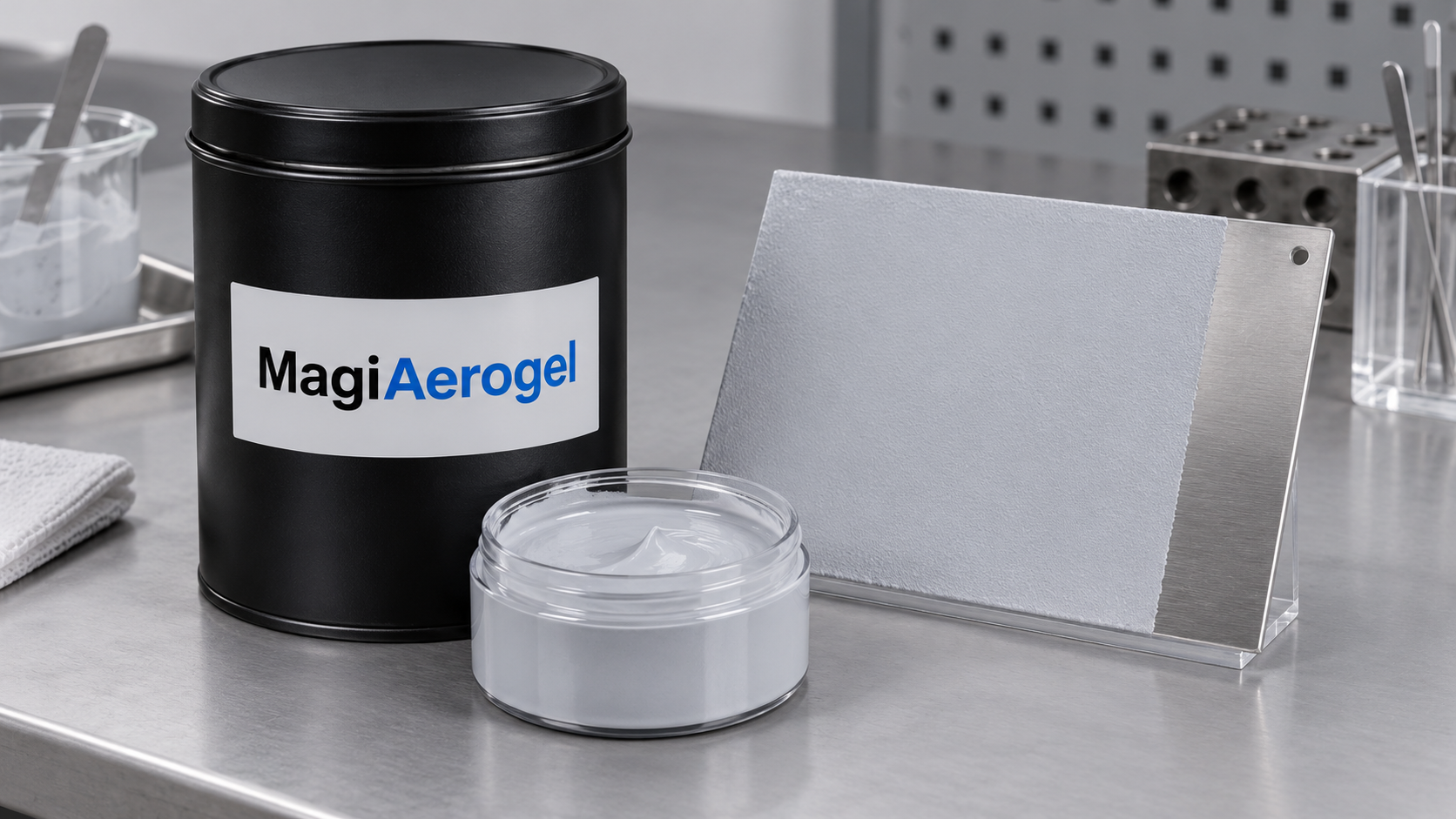

Set the aerogel coating project brief
Record the substrate, target surface temperature, available clearance, service environment, annual area, and application method before comparing quotations. Separate the laboratory trial from the production specification so a small successful panel is not treated as proof of field readiness.
Start with the silica thermal-barrier coating option and ask the supplier to map its intended use to the project brief. Keep the product grade, pack size, and expected coverage in the same request for quotation.
Compare aerogel coating film thickness
Define both wet-film and dry-film thickness. A practical trial may use a 1 to 3 mm dry-film target, but the correct range depends on the formulation, substrate, application tool, and thermal objective. State the measurement method and the allowed variation across the panel.
Ask for coverage in kg/m² or m² per pack at the stated thickness. Coverage without a thickness basis is not enough for a cost or heat-loss comparison. Check whether the quoted consumption includes primer, losses, and touch-up material.
Verify silica aerogel thermal data
Compare thermal conductivity only when temperature, density, thickness, moisture condition, and test method are aligned. For an applied film, record the substrate and cure condition because the coating result is not the same as loose silica aerogel data.
The industrial equipment coating product can be reviewed against the same data sheet checklist. Ask for the continuous and short-term temperature limits in degrees Celsius, plus any restriction on cycling, moisture, chemicals, or UV exposure.
Prepare the industrial surface correctly
Document substrate cleanliness, surface profile, ambient temperature, relative humidity, and the primer or bonding layer. Remove oil, loose scale, dust, and moisture before application. Record the preparation method and inspection result rather than relying on a general statement that the surface was cleaned.
Use a 300 by 300 mm or larger trial panel when the process allows. Mark uncoated edges, measure the substrate temperature, and retain photographs of the prepared surface. These controls make adhesion and coverage results easier to compare between suppliers.
Control application and cure limits
Record order of addition, mixing time, pot life, tool, pass thickness, recoat interval, and cure time. Avoid using a final thickness target without recording the number of passes and the time between passes.
For the metal-surface insulation coating, compare the recommended application sequence with the actual site method. Measure dry-film thickness at multiple points and log any pinholes, runs, cracking, blistering, or edge pullback.
Build a measurable acceptance trial
Use one acceptance record for each trial panel:
- Confirm substrate, preparation method, ambient conditions, and primer.
- Record wet-film thickness, dry-film thickness, coverage, pass count, and cure time.
- Test adhesion after the specified cure period and retain the result with the method used.
- Compare surface temperature or heat-flow results at the same load and measurement points.
- Define limits for visual defects, thickness variation, rework, and failed adhesion.
For background on thin-film performance, read does thin-film aerogel insulation work. For broader energy-efficiency context, consult the U.S. Department of Energy. Keep the final decision tied to measured surface and thermal results.
Review your aerogel coating trial brief
Share the substrate, service temperature, target thickness, coverage, and acceptance limits for a project-specific review.
Frequently asked questions
What dry-film thickness should buyers specify for an aerogel coating trial?
Specify a target dry-film thickness range in millimeters, such as 1 to 3 mm, together with the measurement method and the allowed variation across the test panel.
How large should an industrial aerogel coating trial panel be?
Use a documented panel size such as 300 by 300 mm or larger, and record the substrate, coating mass, wet-film thickness, dry-film thickness, and cure time.
What temperature limit belongs in a coating acceptance plan?
Record the continuous and short-term temperature limits in degrees Celsius, for example 120°C continuous and 150°C short-term, only when those limits are confirmed for the selected formulation.
How many surface-preparation checks should a buyer document?
Document at least four checks: substrate cleanliness, surface profile, ambient temperature and humidity, and adhesion result after the specified cure period.
<script type=”application/ld+json”> {“@context”:”https://schema.org”,”@type”:”FAQPage”,”mainEntity”:[{“@type”:”Question”,”name”:”What dry-film thickness should buyers specify for an aerogel coating trial?”,”acceptedAnswer”:{“@type”:”Answer”,”text”:”Specify a target dry-film thickness range in millimeters, such as 1 to 3 mm, together with the measurement method and the allowed variation across the test panel.”}},{“@type”:”Question”,”name”:”How large should an industrial aerogel coating trial panel be?”,”acceptedAnswer”:{“@type”:”Answer”,”text”:”Use a documented panel size such as 300 by 300 mm or larger, and record the substrate, coating mass, wet-film thickness, dry-film thickness, and cure time.”}},{“@type”:”Question”,”name”:”What temperature limit belongs in a coating acceptance plan?”,”acceptedAnswer”:{“@type”:”Answer”,”text”:”Record the continuous and short-term temperature limits in degrees Celsius, for example 120°C continuous and 150°C short-term, only when those limits are confirmed for the selected formulation.”}},{“@type”:”Question”,”name”:”How many surface-preparation checks should a buyer document?”,”acceptedAnswer”:{“@type”:”Answer”,”text”:”Document at least four checks: substrate cleanliness, surface profile, ambient temperature and humidity, and adhesion result after the specified cure period.”}}]} </script>